Good partnerships.
Better questions.
Start with a company challenge. Find a plausible partner, test the objections, and shape a bounded pilot. Every recommendation keeps its sources and independent review.
Your first three clicks.
- Open a proposal. Overview brings together the company challenge, proposed work, validation plan and conditions to confirm.
- Open an Evidence citation. Compare the excerpt with the original field; origin verification is separate from semantic support.
- Open the real revision story. Read the Critic finding next to its linked before-and-after claims and check the final Run outcome.
System approval records a reviewed proposal. Participation, commercial terms and real-world trial outcomes still need confirmation.
Go beyond the recommendation.
Inspect the source
Open a citation to read the exact original field, excerpt and source identity behind a claim.
FreshPak: packaging and cold-chain pilot →Read the objections
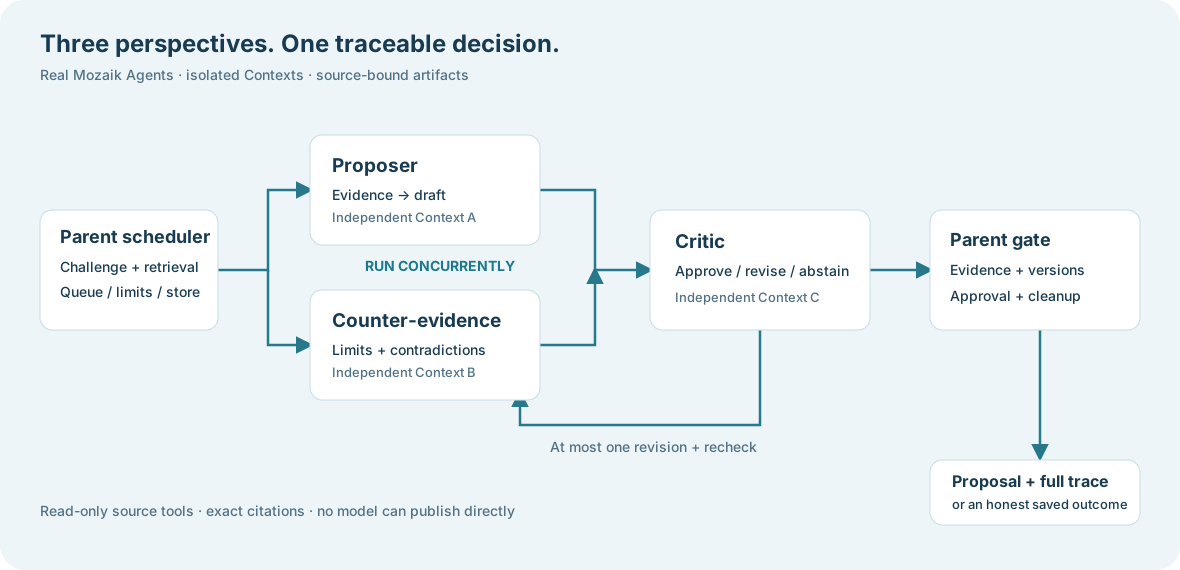
The Counter looks for limits and contradictions. The independent Critic can request changes or withhold approval.
Nexara: EMC screening proposal →Follow what changed
ArmaturaSec has two drafts and two reviews. It ends with insufficient evidence: the product preserves that result.
Read the research revision →Check the full trace
History retains the saved agent activity, outcomes and review versions. A separate seeded revision diagnostic is labelled and excluded from formal proposals.
Open analysis history →Run your own analysis.
This public demo replays real saved results and makes no new model requests. Run the full application locally with your own API key. Tested with Node 24, pnpm 11.25 and Windows.
pnpm install --frozen-lockfile --ignore-scripts
pnpm setup:data
pnpm build:server
pnpm build:web
pnpm demo
For new analyses, copy config/gateway.env.example to .env.local, configure your provider, then start dist/server/server/main.js with Node's --env-file-if-exists=.env.local option.
Download the source snapshot · Open the architecture diagram
What is verified?
Three development pairs passed the source, review and publication checks. The dataset is the official synthetic EINSTEIN corpus. These are proposed pilots, not proven business outcomes. There are no human relevance labels or accuracy claims; held-out cases remain unopened. Source verification checks the cited bytes and identity, not semantic truth by itself.